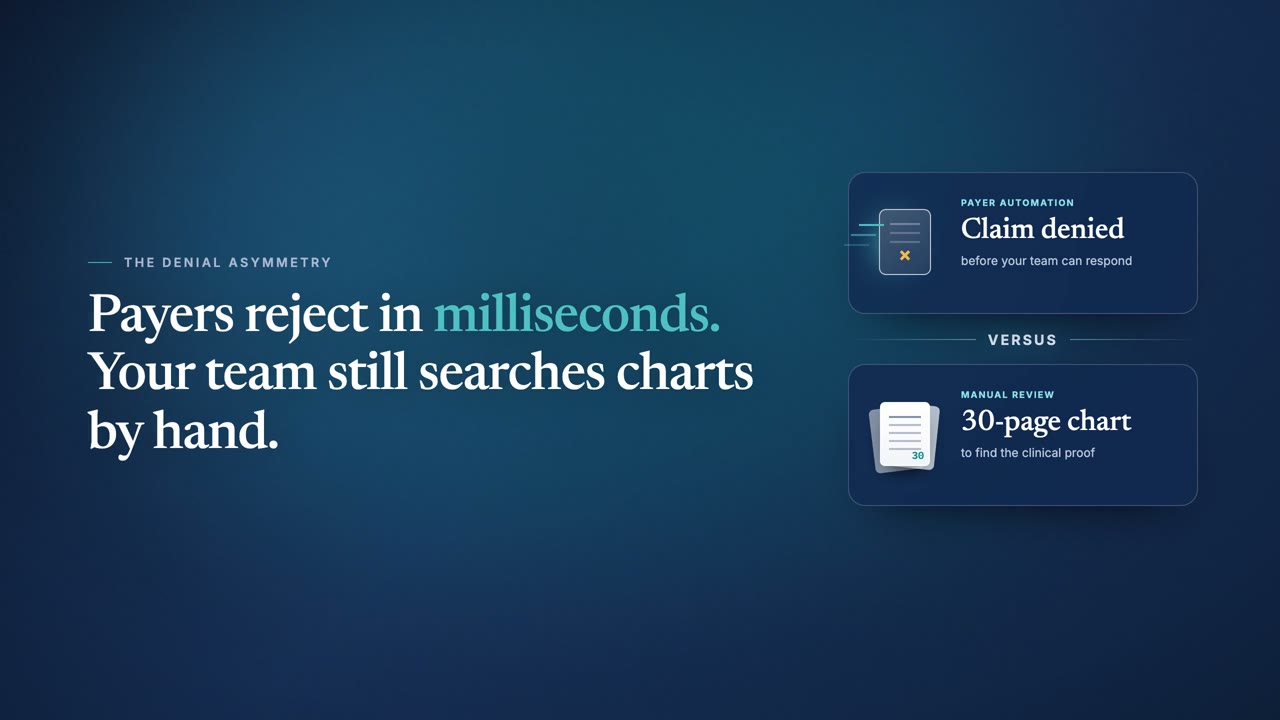
For RCM operators, denial teams, and specialty billing partners

Work more high-risk claims before deadlines turn them into lost revenue.

LogicPearl binds payer policy, source records, and claim data into a traceable result and next action your analysts verify — without adding a clinician to every account or replacing the workflow they already use.

De-identified historical audit No production write-back Source citation on every result Coverage gaps stay visible
See the RCM workflow From denial pressure to review-ready evidence.
Open full demo →
You keep the client relationship and the operating stack

A layer behind your operation, not another provider-facing RCM vendor.

Results can return through approved APIs, file exchange, or existing work-queue interfaces. Your team remains client-facing and keeps ownership of workflow, judgment, and release.

Epic Oracle Health athenahealth eClinicalWorks Waystar Availity Common systems of record; available interfaces are confirmed during integration planning.
The operating pressure

Most denials are decided on the packet the payer received.

Not on the care that was delivered. The supporting evidence is often already in the record — assembling it, matching it to the governing criterion, and returning it inside the deadline is labor your margin has to justify, account by account.

11.6%of claims were initially denied by payers in 2025
2.7%ended as final denials
$48.4Bnet revenue lost to final denials and bad debt, up 25% year over year
43%of surveyed provider organizations reported being understaffed

Kodiak Solutions 2025 benchmarking data · 2,300 hospitals and 350,000 physicians. Read the source. Staffing figure: Experian Health 2025 State of Claims survey · 250 claims decision-makers. Read the source.

01

Policy review does not scale

Analysts still find the governing policy version, the decisive evidence, and the next action — account by account.

Specialist time becomes the capacity ceiling
02

Recoverable inventory goes untouched

When likely recovery cannot justify another manual review, small accounts age out — even when the evidence already exists.

Earned revenue sits outside the labor model
03

Clients expect prevention, not queues

A worklist shows what happened. Clients want the failed handoff, the root cause, and the correction that prevents the next one.

Proof of improvement affects renewals and growth
From packet to analyst-ready exception

See the evidence pipeline, step by step.

This synthetic walkthrough lets you inspect how the source record, verified fact, payer-policy version, and analyst next action stay connected. Pause on any step or advance to the next packet.
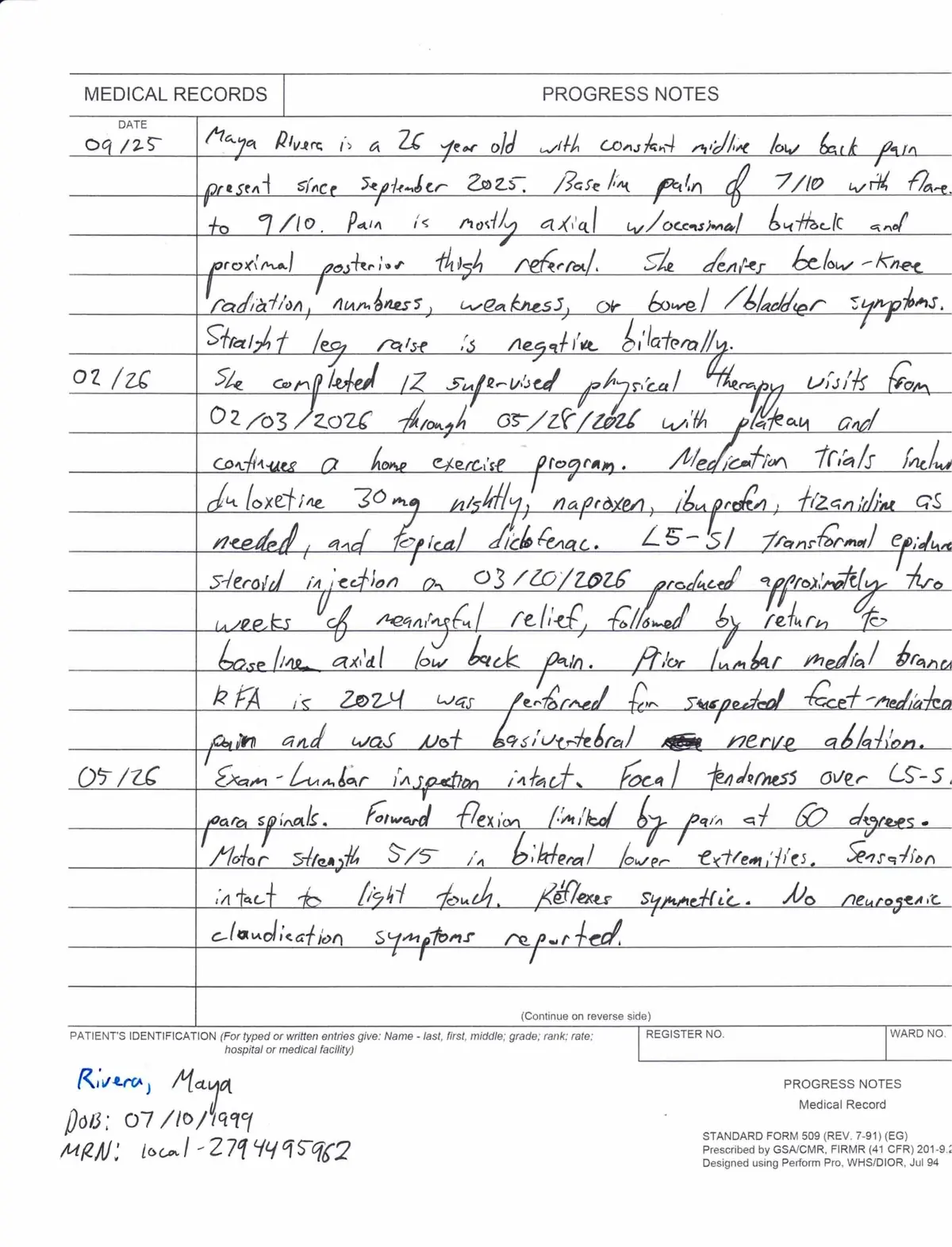
Scanned packet · 8 pages · CLM-20481A scanned packet arrives
Handwritten progress note, page 5 of a scanned prior-authorization packet
Verified fact
Payer policyresolving…
  • Age 18 or overp.1
  • Chronic low back pain > 6 monthsp.5
  • Failed nonsurgical managementp.5
  • Modic type I or II MRI changesp.6
  • No prior BVN ablation at levelp.5
  • 1–2 vertebral bodies per sessionp.4
  • ≤ 4 vertebral bodies per lifetimep.4
What the analyst receivesDetermination pending…

Every criterion links to a page and a span. No policy archaeology.

At risk
Decision due
Analyst touches

Synthetic packet · illustrative figures

Source evidence & payer policy

The original record, the verified fact, and the exact payer rule — together.

Clinical support often lives in scans, faxes, and handwriting, and the governing policy lives in a 40-page PDF. LogicPearl keeps the source page attached to every verified fact and pins it to the criterion that actually decides the claim.
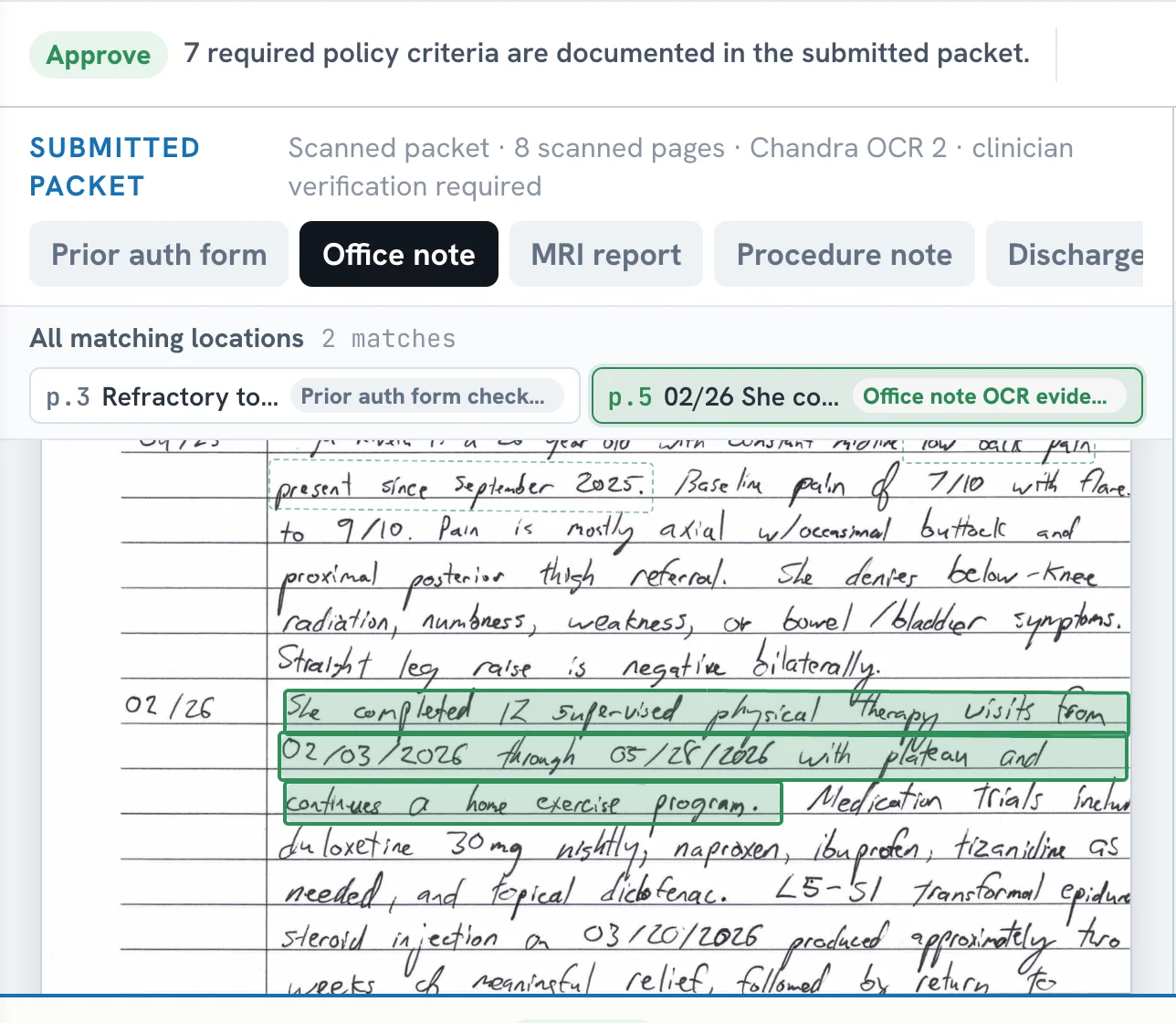
Live workbench source · office note p.5 source preserved
Live workbench office-note view with the handwritten 12-visit physical-therapy course highlighted on page 5
Reused from the live prior-authorization workbench Open the full source-linked demo →
Verified clinical fact physical_therapy_visits = 12 source · office note p.5 · exact span retained
Applicable payer criterion BCBSMA 485 · criterion C03 failed conservative care · source policy p.1
What billing, CDI, and appeals can verify

Whole libraries, loaded and counted — not one rule at a time.

CMS coverage documents, Medicare manuals, and commercial policies load as a versioned source set. Your staff verify the clinical fact; the system then applies the exact criterion deterministically.

  • The payer's published policy is the governing standard, cited by clause and pinned by version
  • Page-level boxes for handwritten and scanned evidence
  • Every accepted fact maps to the exact claim check and policy criterion
  • No model chooses which rule applies or decides the claim
  • Clauses that cannot be safely represented stay in the review queue
See the RCM workbench
Shipped corpus proof Policy coverage is counted, not implied.

A new payer set receives the same accounting before use. Coverage is a safety measure — the scorecard still reports whether denials fell.

99.9%of requirement clauses covered across the BCBSMA policy corpus 468policies compiled into reviewable criteria Visibleevery miss stays in the review queue as named work
Before submission and after the denial

One decision layer for both halves of the work.

The same check that holds a claim pre-bill explains the determination after the fact. Both resolve to the payer's published policy at a pinned version — and name the owner, the correction, and the clock.

Eligibility & registration · CARC 27 / 31 Prior authorization · CARC 197 Medical necessity · CARC 50 Coding, modifiers & NCCI · CARC 4 / 97 Coordination of benefits · CARC 22 Timely-filing exposure · CARC 29
01 · Patient accessIdentity, eligibility, COB, authorization
02 · ClinicalMedical-necessity documentation
03 · CodingICD-10-CM / CPT, modifiers, NCCI edits
04 · BillingReady, or held for one named reason
01 · What did the packet not show? Named criteria, not a reason code.

CARC 50 on a lumbar MRI resolves to the two criteria the submitted record left unaddressed: treatment response, and the neurologic findings connecting diagnosis to study.

02 · Was the denial supported? Reproducible in both directions.

The determination replays against the policy version in force on the date of service. If the denial used a superseded criterion, the trace shows the old rule, current rule, and exact source evidence. When the denial is supported, the account is closed instead of worked.

03 · What happens next? One correction, one owner, one clock.

Route the focused request, verify the returned source, then replay the same rule to show the criteria are satisfied before the deadline — resubmit or appeal.

policy version2026.01 failed criteria2 of 3 appeal levellevel 1 · 12 days left audit historyoriginal denial preserved
Appeal-ready evidence packet Pre-populate the approved appeal workflow with the facts and citations a reviewer needs.

Denial reason, policy version, exact criteria, source excerpts, correction history, and the applicable level and deadline stay together. Final clinical and billing approval remains with your authorized team.

  • Exact payer-policy citations
  • Source excerpts attached
  • Deadline and appeal level surfaced
RCM work queue · Prevention and denial recovery

Choose an account. See the deadline, evidence, owner, and human next step.

Each synthetic account fails at a different handoff — medical necessity, authorization date span, registration identity, and coding laterality. Inspect the denial, prepare the correction request, then verify the returned source and rerun the same rule.

logicpearl.rcm / client inventory review
Synthetic claims Human-controlled decision preview
Client 037 · Specialty group

Maya Rivera

Appeal review
FacilityNorthstar OrthopedicsPayerCrestline Health PPOAmount$1,180
WorkflowDeniedDenial / editCO-50 · Medical necessityDeadlineAppeal due · 12 daysDays in AR47 daysHistory2 prior touchesAssigned queueClinical denials · West
ICD-10M54.16CPT72148Failure pointDocumentation

The denial letter cites medical necessity. The submitted record states symptom duration, but it does not connect treatment response and neurologic findings to the requested MRI.

Claim validation checks1 / 3 satisfied
Persistent symptoms documentedEight weeks of radiating low-back pain is documented.
Progress note · p.2
Conservative treatment documentedSix visits are present, but the response to treatment is not stated.
PT discharge · p.6
Exam supports the requested studyNo neurologic exam finding is linked to the order.
Progress note · p.3
Account-level business case

Prove the operating economics, not an industry-average ROI.

The historical audit pairs every surfaced opportunity with the labor and outcome measures your operations and client teams already manage. The business case is calculated account by account from your own inventory.

01 · Capacity

Accounts worked per analyst

Compare eligible inventory, analyst minutes, and touches against the historical workflow.

02 · Yield

Recoverable dollars surfaced

Separate supported opportunities, non-appealable cases, and claims that still need human review.

03 · Speed

Days to first action

Measure how quickly each account reaches a specific owner and defensible next step.

04 · Quality

False-positive exception rate

Review surfaced exceptions against actual records, edits, denials, and analyst disposition.

05 · Prevention

Recurrence by root cause

Show clients which registration, authorization, documentation, or coding handoffs keep failing.

06 · Governance

Policy and evidence coverage

Count what was represented, what was source-verified, and what remained outside safe automation.

RCM partnership boundary

You remain the RCM partner. LogicPearl powers your operation.

Your team keeps the provider relationship, analyst judgment, proprietary playbooks, and release authority. LogicPearl adds a claim-validation and evidence layer behind the workflow.

Your operation stays client-facing.

The RCM workbench, EHR, encoder, clearinghouse, and client-facing reporting remain the systems and services your team owns.

  • Your analysts make the final disposition
  • Your team owns provider communication and SLAs
  • Your authorized staff release, resubmit, or appeal

LogicPearl returns a defensible work item.

It associates verified facts and source documents with versioned payer rules, then returns the reason, proof, owner, and smallest safe next action.

  • Structured results through approved API or file exchange
  • Customer-controlled runtime options
  • Source-linked, versioned receipts and coverage gaps
Historical firstProve fit without production write-back.
Client isolationConfirm the data, policy, and deployment boundary before integration.
Human authorityNo autonomous coding, documentation change, release, resubmission, or appeal.
Branding by agreementAny client-facing use or output is defined with the RCM partner first.
Role-based routing
Patient access

Member identity, eligibility, and authorization corrections

CDI / ordering clinic

Focused medical-necessity documentation query

Coding

Diagnosis, procedure, modifier, and laterality clarification

Billing / appeals

Release, resubmit, or review the appeal-ready evidence packet

Historical claims audit

Audit one denial family before changing a workflow.

Bring a de-identified historical queue, its records, denial outcomes, and the policies your team already applies. LogicPearl returns a case-level opportunity file and operating scorecard without touching production.

Bring

One bounded historical queue

Claim and denial context, source records, actual disposition, analyst touches, and the applicable payer policies.

Receive

A case-by-case opportunity file

Exact evidence and policy citations, recommended owner, safe next action, and explicit non-appealable or needs-review cases.

Decide

Where the economics justify integration

Capacity, yield, speed, recurrence, policy coverage, and the client or service line worth taking forward.

A useful first conversation Bring your most expensive manual bottleneck, not a polished innovation brief.

Tell us the denial family, rough volume, and the metric your operations team already reports. We will scope the audit from there.

Audit a client queue
FAQ

The practical questions

What does a pilot use?+

A de-identified historical claims audit using source documents, edits, denial outcomes, and the policies or rules your team already applies. Production stays unchanged while the results are compared with your baseline.

Which denial families does LogicPearl cover?+

Eligibility and coordination of benefits, prior authorization, medical necessity, coding coherence including modifiers and NCCI edits, and timely-filing exposure. Coverage for a given client depends on which source records and payer policies the audit receives, and any family outside that set is reported rather than assumed.

Does LogicPearl generate appeal letters?+

LogicPearl assembles an appeal-ready evidence packet containing the denial reason, applicable policy version, exact criteria, source excerpts, and correction history. That packet can populate an approved appeal template, while final clinical and billing review stays with the authorized team.

Can the rules run inside our environment?+

Yes. LogicPearl decision artifacts can run in the browser, at the edge, on a server, or in customer-controlled infrastructure without requiring a new primary workflow system.

Can LogicPearl process complete CMS, BCBS, or other payer policy libraries?+

Yes. The pipeline ingests policy PDFs, tables, appendices, and updates as a versioned source set, compiles supported clauses into checkable criteria, and reports any uncovered clauses rather than silently skipping them. On the shipped BCBSMA corpus that produced 99.9% requirement-clause coverage, with every miss kept visible as review work; a new payer set receives the same accounting before use.

What happens with scanned or handwritten clinical records?+

LogicPearl converts the record into source-bound clinical facts while preserving the original page and location. Document understanding and rule evaluation remain separate: once a fact is verified, it is associated with the exact applicable policy criteria deterministically. No model guesses which governing rule applies or decides whether the claim passes.

Recover lost revenue before claims run out the clock.

Start with one de-identified queue, one denial family or specialty, and a case-by-case operating and business readout—before production integration.

Audit a client queueSee the RCM workbench