Requests arrive as faxes and copied-forward chart notes. Policies arrive as PDFs with nested exceptions and tables. LogicPearl turns both into one answer per case: ready, blocked, or missing evidence, with the proof attached.
Faxes, scans, duplicate uploads, copied-forward chart language.
Turning a policy PDF into configured rules takes analysts weeks per policy.
Clinicians page through packets looking for the sentence that decides the case.
The same packet gets different answers depending on which model you ask, or which run.
Decisions that cannot replay turn every audit into archaeology.
A changed PDF becomes a silent, unverified rule change.
This is not a platform migration. It's one boundary, made deterministic:
Intake, routing, letters, timers, reporting: the workflow system you run today stays exactly where it is.
OCR built for clinical paper: faxes, scans, and handwriting, with every finding tagged by evidence state. Already run extractors? Their output plugs in too.
At the moment of determination, policy rules decide deterministically, with the criterion, evidence span, and source excerpt sealed into a receipt.
Published payer medical policies, converted into checkable criteria with verbatim source excerpts. The clauses the compiler couldn't cover are preserved as visible review work, and policies without full support stay out of auto-run.
Measured on the Blue Cross Blue Shield of Massachusetts policy corpus. The same coverage accounting can run against any payer policy set before a pilot starts.
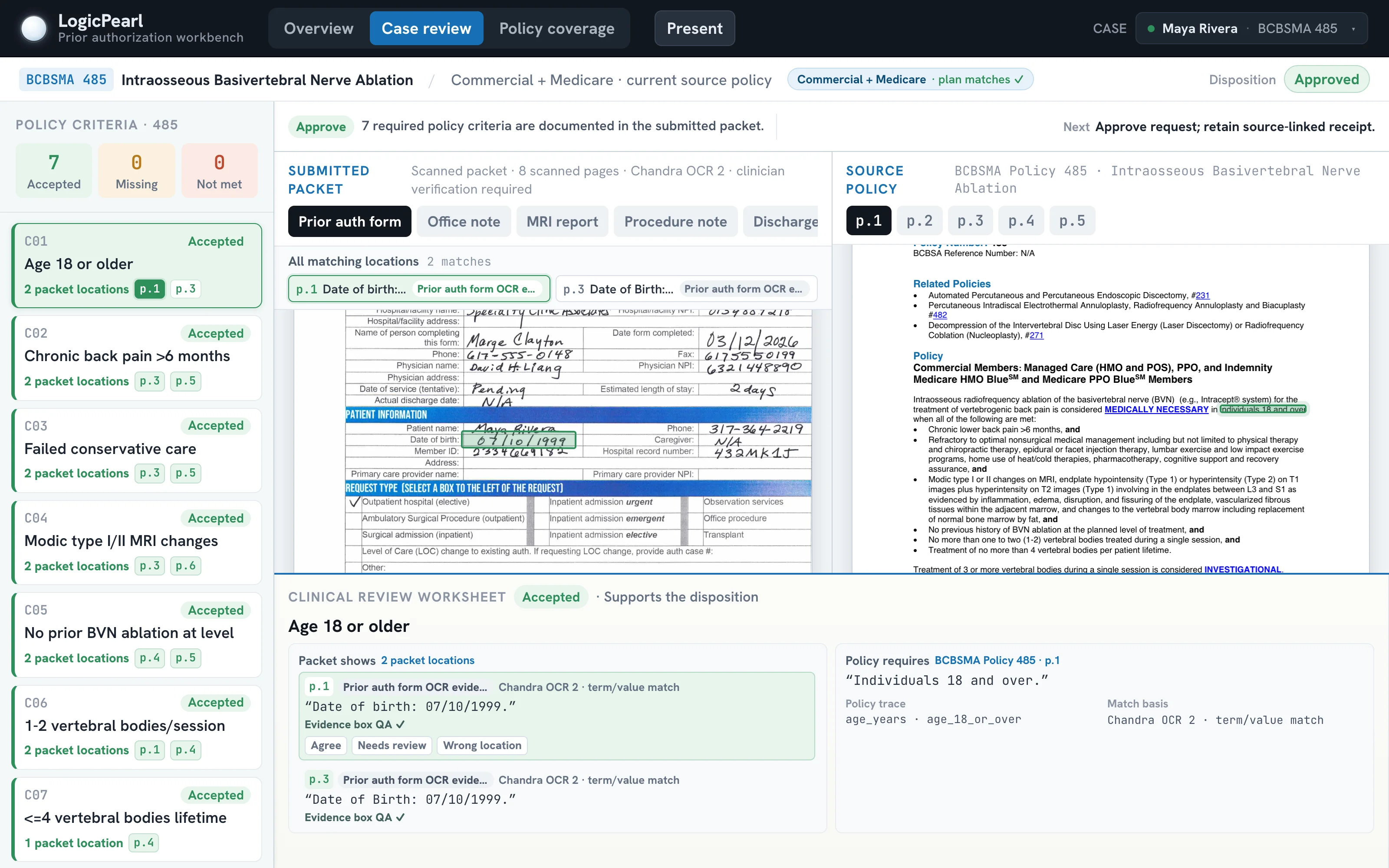
Every criterion links to the packet span that satisfies it and the policy text that requires it. Contradictions, such as left-side pain on one page and right-side pain on another, route to review instead of being silently resolved.
This is the live prior-auth workbench with evidence boxes drawn on the scanned handwriting, criteria linked to packet locations and verbatim policy excerpts, and the audit-ready record behind every disposition. It runs in your browser.
We gave frontier models the exact policy text and the same packet. Across 8 model groups, 24 recorded determinations came back 20 approve, 4 deny, with rationales that drifted run to run. Model choice is not a clinical policy, and at scale that variance is rework, leakage, and audit exposure.
The appeal side is where it compounds: industry-wide, most appealed denials are overturned, overturn rates feed CMS Star Ratings, and a denial defended with a new reason mid-appeal restarts the clock. A determination that ships with its rule, evidence, and source excerpt doesn't have that problem.
A bounded batch in shadow mode: your cases, your policies, a case-by-case readout.