The packet arrives
It arrives as faxes, scans, copied-forward chart language, and handwriting. Before anyone can apply the policy, the case has to become evidence a reviewer can inspect, with the page each fact came from.
The job: preserve where every fact came from while turning the packet into reviewable evidence.
Prior auth · lumbar radiofrequency ablation
- Requested
- CPT 64635 · L4–L5, right
- Diagnosis
- M54.16 · lumbar radiculopathy
- Payer
- Commercial PPO
24 recorded determinations
Three recorded runs per model group. Haiku changed its own answer; matching verdicts still cited different criteria.
AI proposes the evidence
Document and language models find candidate evidence in the packet. Their answers can drift across vendors and reruns, so LogicPearl keeps that work in the evidence step, where every finding can be checked.
The boundary: models may propose facts; they do not become the policy of record.
Policy rules make the repeatable call
The compiled policy artifact evaluates the same criteria the reviewer has to defend: what is satisfied, what is missing, what conflicts, what blocks the case, and what would make it ready.
An MRI dated within 90 days of the request, and reviewer sign-off on the laterality conflict.
Request missing evidence
Records request drafted for imaging; laterality conflict routed to the nurse-review queue.
§2.b · imaging recency · p.4 of source PDF
quote hash sha256:9f3c...a41e
A reviewer verifies the proof
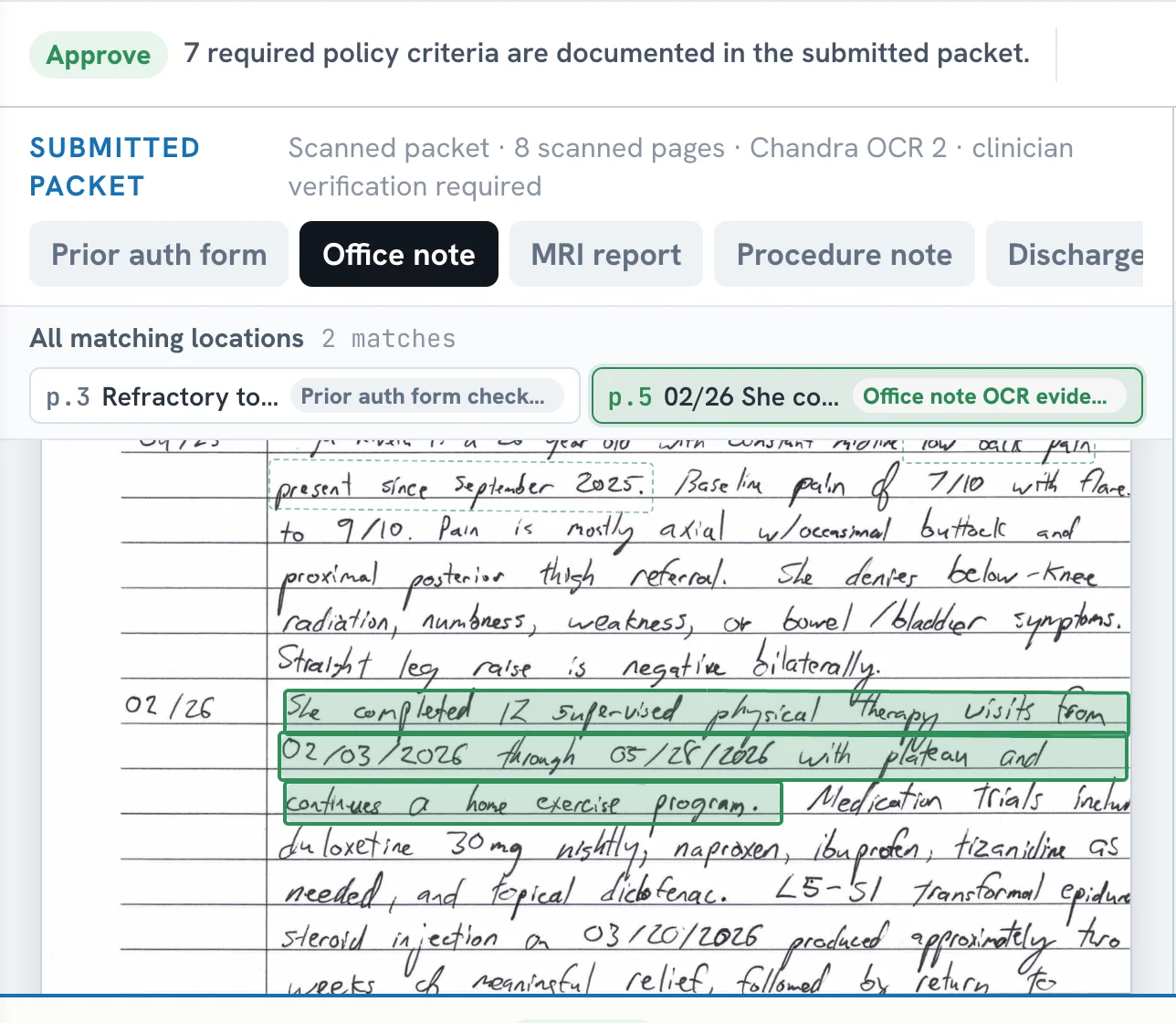
The reviewer sees the case and policy together. Each criterion links back to the packet location and the verbatim source-policy excerpt, including OCR QA state for uncertain or handwritten evidence.
- Evidence boxes anchored directly to the scanned page
- Policy requirements linked to source text and page
- Agree, flag, and reject states for every proposed match
The receipt preserves the decision
The packet, evidence spans, rule, source policy, reviewer history, and exact artifact version stay bound together. If a policy changes, the semantic diff explains why the same case would route differently, and the original record stays as it was.
Why an answer changed is a question you can answer.
Run the same case against the April source set and it routes to review. No covering policy existed yet. Run it against June, where a new policy took effect on the first, and it decides. Same case facts; the source set changed. That is an explanation an auditor accepts, and a model can't give.
When a payer updates a policy PDF, LogicPearl shows what changed between versions and which open cases it affects, before they surprise you.
When a denial comes back, the first question is which criterion it turned on.
LogicPearl keeps the rule, the evidence, and the policy version bound to every result, so an appeal starts from the exact criterion the payer applied and the chart page that meets it.